
WHO - WHAT - WHEN - WHERE - WHY - HOW
|
3/22/2024 As Tentative definition for hempseed meal Moves forward, APS Constituents Have Concerns (Title update: April 4, 2024)Read Nowas TENTATIVE DEFINITION FOR HEMPSEED MEAL Moves forward, APS Constituents have concerns Update (Shared via LinkedIn Friday March 29th, 2024):
We are happy to report that HFC and APS will be working together to ensure the tentative hempseed meal ingredient definition is updated as soon as possible after acceptance to reflect industry standards. We did receive clarity that the current 2ppm limit on THC in hempseed meal listed in the current definition was achieved with neither dehulled or triple washed hempseeds, our constituents have expressed concerns over the 2ppm THC limit and the CBD inclusion and we will continue to represent those concerns as we collaborate. We look forward to achieving an outcome that drives hemp feed market development for our farmers, processors and feed formulators. Original: The partners at APS have been dedicated to the fruition of hemp as an animal feed since our engagement with the original submission at the Hemp Feed Coalition. While we are happy to see the recent tentative definition return from the FDA-CVM after nearly four years of waiting. We feel it is necessary to address the current definition and its impact on our industry. Without reasonable limits that are attainable by the regulators, or achievable by farmers and processors who need secondary markets like animal feed, the definition becomes a pathway for a few and not a viable market. In conversations with other associations and agencies, cautionary statements have been shared that the current tentative definition is not economically feasible; requiring solvent washing or dehulling. The proposed definition does not require dehulling nor do the limits proposed by the FDA-DVM align with any reported safety concerns, OR their own established limits in the accepted GRAS notice for hemp seed and its by-products to be consumed by humans. The goal of this blog is to introduce this conversation over the next couple of weeks and include the perspectives of other subject matter experts, farmers and market leaders, with the request from our industry to revise the definition to its original submission limits of 10ppm THC and not action limit for CBD. The definition and the rationale for this change are introduced below and I look forward to an ongoing dialogue and work that will open animal feed markets to hemp rather than reduce the volume of compliant supply and increase the cost for those eager to feed hemp to amounts that are unsustainable for the feed industry. New Tentative Definition T71.5 Hempseed Seed Meal, Mechanically Extracted T71.5 Hemp Seed Meal, Mechanical Extracted is the product obtained by grinding or milling the cake, which remains after most of the oil is removed from the seeds of Cannabis sativa L. by a mechanical extraction process. The ingredient must be labeled with guarantees for minimum crude protein and maximum crude fat on an as-fed basis. The meal shall contain no more than 20 ppm of total cannabidiol (Total CBD = CBD + (CBDA x 0.877)) and no more than 2 ppm of total tetrahydrocannabinol (Total THC = delta-9-THC + (THCA x 0.877)). It is used in diets of laying hens as a source of protein and fat at an inclusion of no more than 20% of the diet. 1. The original submission was sent to the FDA-CVM from the AAFCO Oilseed Ingredients investigator after their initial review had a 10ppm limit for THC and no limit for CBD. 2. The basis for the proposed limits were the FDA GRAS notice for whole hempseed oil. 3. The analytical capabilities at the time of submission required an LC/MS/MS and could not be achieved with a GC-FID method. (There is work to validate a GC-FID method for hempseed meal to 10ppm by ASTM right now) 4. There is no jurisdiction that has a limit for CBD in hempseed meal. 5. The US Pharmacopeia defines hempseed meal with less than 10ppm THC, and less than 75ppm. 6. The proposed limit of 20ppm CBD is less than the acceptable amounts of lead and arsenic in animal feed. 7. The proposed 2ppm THC limit is the same amount of Mercury allowed in animal feed. Only cadmium is lower. 8. There is no scientific research that these very low limits have any toxicity or affect animal or human health negatively. (compliant hemp is allowed 3000 ppm ∆9 THC, and there is no limit on CBD) 9. To prevent cannabinoid contamination in hemp seed by products (FDA recognizes the seeds do not naturally produce cannabinoids) the seeds would have to a. be cleaned three times before processing b. be dehulled 10. Farmers and seed processors cannot afford the margins to clean or dehull grade B seed – which is ideal for the animal feed market needs for supply volumes and cost. 11. Crushing hempseed hearts are marketed as high value protein powder that is most often for human consumption and will not support the development of a hemp grain supply chain economically. The above ten bullet points will be discussed further in three upcoming blogs posts by my team, trusted researchers, processors and feed formulators. I hope that you will engage us with your questions. The goal of the series is to address these issues, before the final approval of this definition by AAFCO in August and before these limits are imposed on the hemp industry.
1 Comment
The global hemp industry needs Science not Sensationalism The Federation of International Hemp Organizations (FIHO) supports research and science aimed at the development of new hemp products and markets including animal feed stocks. A recent article sensationalized hemp fed cows as intoxicated without any scientific review of the study, its intentions or results. The regulatory pathway for hemp feed is being developed by scientists and researchers, who depend on standards, validated methods and peer review like that presented by Dr Bernhard Beitzke and Dr JC Callaway1 . Industrial hemp grown for fiber and grain has thousands of years of history and use across the world, but its regulation is still being navigated because much of the science is new. As states and countries struggle to regulate an old crop with new research and analytical capabilities, the need to understand hemp as plant supplements, food and fiber are being mingled with the scrutiny of marijuana and intoxicating cannabinoids. This confusion between hemp and its psychoactive cousin has impacted farmers, consumers, policy makers and spilled into the media. A recent article2 on a Risk Assessment Study of the BfR (German Federal Institute of Risk Assessment) capitalized on this confusion and further exacerbated the regulation of hemp products as animal feed by popularizing a risk assessment study of high THC containing feedstock, with a feed research trial. The lack of clarity as to what material was fed, its composition before ensiling, its nutritional and processing description, or potential contaminants was left out of the press release, and instead the headlines read ‘cows fed hemp were intoxicated’. Unfortunately, the article was popular and the study on ‘cows high on hemp’ was everywhere. While the article gained international press when it was published in 2022, the study had gone unscrutinised after its publication; leaving questions about the ingredients, study methods and the intention of the work itself. The Association of Standards, Testing and Materials (ASTM) hosted a webinar focused on the analytical chemistry and standards needed to regulate hemp products as animal feed. The workshop presented research and test results by Chemists, Scientists and Animal experts from across the world including: United States, Canada, Germany, and Australia. The discussion centered around current research and the need for validated methods to quantify cannabinoids in feed and animal by-products, at levels that are attainable by regulators and the establishment of appropriate guidelines for animal and human safety. With these goals in mind, Dr. Bernhard Beitzke presented a scientific review of the Risk Assessment Study. He also shared some of the findings from him and his research partner, Dr. JC Callaway, published already as a preprint3 . A revised manuscript is currently under review for publication in Nature Food. The goal of the presentation was to present a critical review of this study in relation to previous hemp silage studies and assess its conclusions of risk potential. The authors investigated the feed materials finding that one was primarily flowering tops and leaves, it was spoiled silage and contained high concentrations of THC, while the other was representative of whole plant hemp silage that would become feed. The detailed assessment also reviewed the cannabinoid content along with the comparison of THC to THCA, an important measurement for calculating the amount of the psychoactive THC molecule that can be absorbed by the animal. The results of the original study fall disastrously short without an approved analytical method open to scrutiny, and no way to repeat, compare or analyze results. The scientific value of the assessment presented by Dr Beitzke and Dr Callaway spotlights the need for education of farmers on the use of industrial hemp as feed, as well as additional research and the development of analytical methods accessible to researchers and allowing data collection and analysis. With the current legislation and rule-making language that uses non-detectable limits or zero, there is a need to rely on scientific rigor and safety assessments4 , not sensational headlines that drive confusion and misbrand safe hemp products already being utilized as food and feed around the world. The Federation of International Hemp Organizations (FIHO) supports research and publications that drive innovation and understanding across the world and encourage dialogue and scrutiny as we develop a global hemp industry. FIHO would like to thank researchers, in particular Dr Beitzke and Dr Callaway, doing great work by writing this critical review, and for the continuation of their work. Dr. Bernhard Beitzke Bernhard Beitzke is a chemist with over 30 years of experience in the chemical and pharmaceutical industry in research & development, production, procurement, HSEQ and chemicals registration. Since 2015 he has been working as an independent consultant for the hemp industry, since 2017 he has been a member of the scientific advisory board of the European Industrial Hemp Association (EIHA). He published various contributions on industrial hemp, and on the toxicology and pharmacology of cannabinoids, in particular on THC and its risk assessment for determination of a reasonable Reference Dose. 1 JC Callaway and Bernhard Beitzke, Matters Arising re. Wagner et al., submitted to Nature Food, 07.06.2023, awaiting publication. 2 Wagner et al. (2022), Transfer of cannabinoids into the milk of dairy cows fed with industrial hemp could lead to Δ9-THC exposure that exceeds acute reference dose, Nature Food, 3(11):921-932, https://www.nature.com/articles/s43016-022-00623-7 3 https://chemrxiv.org/engage/apigateway/chemrxiv/assets/orp/resource/item/642aef9cdb1a20696e758152/original/using-science-as-atool-to-shape-political-opinion.pdf 
FEDERATION OF INTERNATIONAL HEMP ORGANIZATIONS’ POSITION ON HEMP TERMINOLOGY Brussels, May 10, 2023 – Since the 14th century, Cannabis sativa L. and all of its many products have been called by the English common name “hemp” and similarly generalized names in other languages. Since the 20th century, countless attempts have been made to establish a reliable scientific distinction between intoxicating “high-THC” cannabis-derived products and non-intoxicating (industrial) “hemp” (lat.: Cannabis sativa L., commonly known in commercial production and trade as “hemp”) products. Industrial Hemp is now commonly employed to designate fibre and oilseed cultivars for C. sativa with very limited content of the intoxicating chemical THC.
Although “high-THC” cannabis and “hemp” industries are clearly distinct, it appears that delineating between industrial hemp (hemp) and high-THC cannabis is challenging for regulators. With this in mind, the Executive Board of the Federation of International Hemp Organizations (FIHO) adopted a position on Hemp Terminology, approved unanimously after concertation with all parties and members. With this proposed terminology, FIHO intends to help policy makers and the Hemp Community use a common language when referring to HEMP at a time when the sector is expected to grow and develop like never before. “Humankind’s global relationship with hemp spans millennia; with production and trade in a large array of hemp products, used for many purposes across time, continents, and civilizations. It is about time that we use the same language and terminology across continents to define Hemp in all its aspect!” declared Ted Haney, Board Chair of FIHO and President of the Canadian Hemp Trade Alliance. Indeed, few agricultural crops thrive in such diverse climates and provide such a wide range of uses as hemp. Hemp offers abundant opportunities for smart agriculture, climate mitigation and adaptation, resilient rural economies, and increased domestic self-reliance in food security and manufacturing. The hemp plant provides real value: its seeds provide protein- and energy-rich human foods and livestock feed ingredients; the (early harvested) leaves also provide an excellent source of plant protein and traditional ingredient for herbal tea infusions; its flowering tops provide wellness products that are in high demand by consumers worldwide; Rue du commerce 31 1000 Brussels, Belgium [email protected] 2 and, its stalks provide thousands of wide-ranging applications in textiles, paper, building materials, renewable energy, advanced composites, bioplastics and more. “With this new position on terminology, major global actors of the hemp sector show their capacity to work together and speak with one voice, we now expect policy makers to embrace this position and apply common terminology in all regions and countries of the world!” said Daniel Kruse, Vice Board Chair of the FIHO and President of the European Industrial Hemp Association. In the next period, FIHO will communicate with policy makers both at national and international level to ensure this terminology facilitates the expansion of the global market and support producers, manufacturers in their contacts and relations with their counterparts. 4/21/2023 ASTM Workshop on Methods For hemp Animal Feed Ingredients and Hemp feed animal productsRead Now
In 2018 when the Hemp Farming Act passed and allowed for the legal cultivation of hemp in the US, the optimism was unbridled and the approval of hemp as an animal feed seemed right around the corner. At the time, whenever I spoke about the regulatory approval process it seemed like I was always the bearer of bad news that no one wanted to hear… that federal approval for hemp as an animal feed ingredient was going to be 3-5 years away.
Now it is 2023 and wow have I learned a lot. Inevitably, the more you learn, the more you come to understand what you do not know as well. My goal in hosting the upcoming ASTM hemp as animal feed workshop is to bring together animal scientists, analytical chemists, regulators and the feed and hemp industries to have a candid discussion about what we know, where we need to develop resources and to acknowledge what we still need to investigate to ensure the safety of hemp as animal feed ingredients and the resulting animal feed products intended for human consumption. The ASTM workshop will host researchers and experts from the US, Canada, Australia, and Germany for two days of presentations and panel discussions. The aim is to build partnerships to develop standards and appropriate regulatory guidance for quantifying cannabinoids in feed and animal by-products. This may seem redundant; but for many of us the challenge for achieving regulatory approval has not been understanding nutrition or contaminant content, (allow there are still some gaps to be addressed), but the difficulty in measuring very small amounts of cannabinoids in hemp seed products and animal tissues. While many private labs and Universities have developed methods to investigate trace amounts of these compounds, what remains missing are standard methods and comparable limits of detection that can be utilized by feed manufacturers and public labs charged with ensuring the safety of our feed and food supply. My hope is that by the conclusion of the ASTM workshop, partnerships between researchers and labs, industry and regulators and the agencies and standardization bodies will culminate in a commitment to work together to close method gaps and recommend standards. We continually hear that there is a desire for zero cannabinoids and THC free products; but in a world where quantification limits can be achieved to part per trillion and we accept solvent residues and small amounts of heavy metals in our food; zero is not an appropriate goal. There is much to be done to create confidence in hemp feed ingredients, the animal products that result and to finally create consistent, achievable regulatory standards that the agencies and consumers can rely on.  Hunter Buffington, Tillery Sims and Jessica Scott quite literally live on 3 opposing points in the United States. Colorado, Texas and Indiana couldn’t be farther apart from one another physically. Their agricultural systems respectively represent their regional traditions, climates, culture and so much more. Read more about each of the team members individually here. Despite these distances and differences, the three of them have brushed elbows, collaborated and worked alongside one another for many years. Now, they are grateful to say they have the privilege to work with one another every day under their new company: Agriculture Policy Solutions (APS).
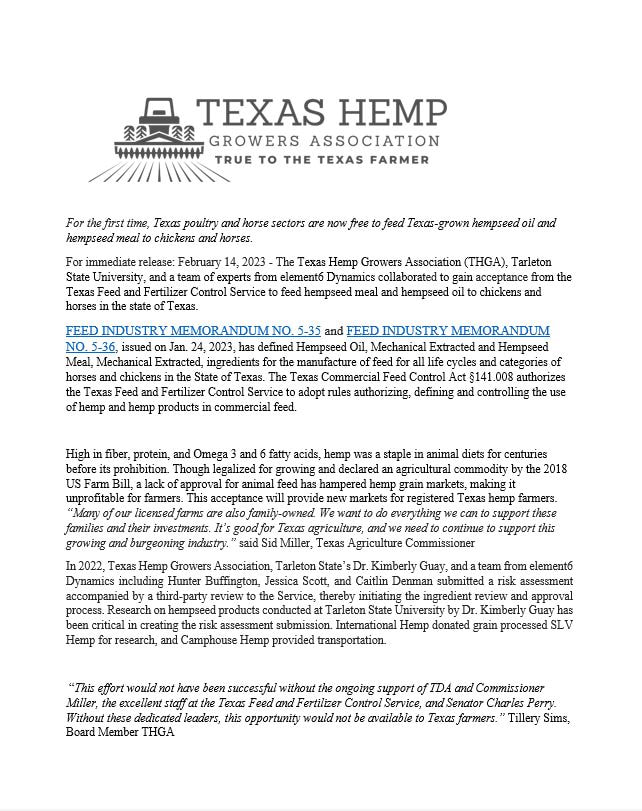
The unification of these three has been a long time coming. Individually, they have developed highly desirable and effective professional skill sets that have served employers, clients and non-profits alike. Their first work together was cultivated years ago in the emerging industrial hemp industry. Like any new industry, there was a call for industrious, smart, determined and innovative individuals to carry incredible amounts on their backs with little promise of return. Most recently, the three had the privilege of working together to submit feed approval applications for Hempseed Meal and Hempseed Oil for Horses and Chickens in Texas and Kentucky. They secured state wide approvals and opened animal feed markets for hemp products for the first time in the US. They see a problem, they solve it. They see an opportunity, they pursue it. With their individual and now team success under their belt, the three decided to officially create Agriculture Policy Solutions. APS represents the culmination of years of identifying solutions to roadblocks and needs for farmers and ag businesses. The team's creative problem solving has moved projects forward methodically across the finish line. All three founders of APS have spent years in the non-profit space and have all wished there was more support to accomplish the incredible missions they were tied to. Creating APS ignited the ability for these three women to take the reins on developing projects and support (with all of the benefits of a consultancy) for both companies and NPO’s to drive missions forward to see real results. No room for fluff, cutting the fat. Getting done what women do best: doing 20 things at once and completing as close to perfection as possible. Currently it’s March 3rd, the second day of Women’s History Month. Women in Agriculture, specifically, will be the way APS chooses to enter the digital world and say “Nice to Meet You”, here is female excellence in agriculture. They will be sharing stories of brilliant female scientists, cultural stories we can see acting upon agriculture today, current female leaders in agriculture and so much more. You are invited to follow them along the journey while they provide solutions for ag innovators at: #agpolicysolutions #ladiesofAPS Instagram @agpolicysolutions Facebook: @AgPolicySolutions LinkedIn: Agriculture Policy Solutions Call for Presentations Issued for 2023 Cannabis and Hemp Industry Events ASTM International has issued calls for presentations for two upcoming events organized by its cannabis committee (D37).
The first of these, the Workshop on the Analytical Methods for Hemp Products as Animal Feed; How to Overcome Gaps in Matrices, Detectors and Quantifiable Limits for Regulators and Laboratories, will be held virtually from April 24 - 25, 2023. The purpose of the workshop is to bring analytical chemists and regulators together to understand what analytes and levels of quantification are currently achievable for multiple matrices. Hemp as an animal feed is highly desirable by hemp producers and the pet and livestock industries. However, there are a limited number of methods approved to quantify trace amounts of cannabinoids in grain products. New methods and standards are needed as well as methods developed that can analyze the trace amounts of cannabinoids that may be transferred into animal tissues and animal by-products intended for human consumption, like meat, milk, and eggs. For more on the workshop, including technical chair information, visit https://go.astm.org/animal-feed-workshop. The second of these events, the Symposium on Contaminants in the Cannabis and Hemp Industry and Their Impact on Consumer Safety will be held virtually Oct. 10 – 12, 2023. This symposium will provide a forum for evaluating the current evidence and gaps regarding the presence and measurements of contaminants that pose a risk to consumer health and safety in cannabis and hemp products with a focus on evaluating the sources of contamination (including cultivation, plant uptake, extraction, processing, manufacturing, packaging, and delivery, etc.) and how they can be mitigated. For more on the symposium, including symposium chair information visit https://go.astm.org/D37-contaminants-symposium. To participate in the workshop or the symposium, authors must submit a 2 to 3-page extended abstract using an appropriate template available from the Abstract Submission Portal. The deadline for the April workshop is Feb. 28, 2023, and for the October symposium, it is March 31, 2023. To ensure your abstract was received into the ASTM database, please email [email protected] and let us know that you have submitted an abstract. About ASTM International Committed to serving global societal needs, ASTM International positively impacts public health and safety, consumer confidence, and overall quality of life. We integrate consensus standards – developed with our international membership of volunteer technical experts – and innovate services to improve lives… Helping our world work better. Symposia Operations Contact: Tammy Schane, tel+1.610.832.9522, [email protected] Release #11595 ### 11/18/2022 FIHO is Established as First Global Hemp Federation; Hunter Buffington to serve as USA Chair of Sustainability CommitteeRead NowFIHO IS ESTABLISHED AS FIRST GLOBAL HEMP FEDERATION; HUNTER BUFFINGTON TO SERVE AS USA CHAIR OF SUSTAINABILITY COMMITTEESaskatoon, November 18, 2022 - The Federation of International Hemp Organisations (FIHO) held its first Annual General Meeting and elected its founding Board of Directors. This signals the transition from interim leadership to an established official organization.
A working group of 20 global hemp organizations joined forces in 2020 and began the process of creating FIHO. An interim Board was appointed in December 2021 to establish the organization. The mandate of the new FIHO is to: unite industry leaders; consolidate market expertise; coordinate resources; and, speak with one voice on hemp issues at the global level. FIHO will identify and create opportunities, and scale up sustainable hemp production, marketing and trade to benefit the global hemp industry, consumers, and the environment The first Annual General Meeting also provided the opportunity to announce the appointment of Mr. Fredéric Vallier as the new FIHO Director General. Frédéric is an experienced executive who served as Secretary General of the Council of European Municipalities and Regions for the past 12 years. He brings strong organizational skills as well as expertise in sustainability, industry engagement, and government relations to FIHO. Mr. Vallier will hold executive functions, manage FIHO operations, and report directly to the newly elected Board. Fredéric Vallier said “I am honoured to become the first FIHO Director General and I thank the Board for putting their trust in me.” He continued by confirming that "hemp is at the heart of the transition towards a more sustainable society. My goal, as Director General, is to build a strong international federation able to influence international policies to support the development of hemp and its derived industrial products.” Ted Haney, newly elected Board Chair, added that “the combination of a strong membership, committed Directors, and expert management will ensure a successful launch. The formation of FIHO represents the next important milestone in the development of the global hemp industry.” The new FIHO Board includes the following global hemp industry leaders: Position Elected Officers Member Organization Region Board Chair Ted Haney CHTA Canada Board Vice-Chair Daniel Kruse EIHA Europe Treasurer Patrick Atagi NIHC USA Secretary Charles Kovess AIHA Australia - 2 - The following committees were established to coordinate the work of the organization and are in the process of defining their roles and responsibilities, and recruiting members: Committee Committee Chair Member Organization Region Communication and Engagement Lorenzo Rolim da Silva LAIHA Brazil Policy and Regulations Lorenza Romanese Rick Fox1 EIHA Europe USA Research and Standards Keanan Stone Michael Bronstein CHTA ATACH Canada USA Sustainability Hunter Buffington Terry Grajczyk1 NIHC USA Canada Other Directors that complete the Board include: Position Elected Directors Member Organization Region Director Joseph Hickey Sr. KYHA USA Director Kyle Bingham TxHGA USA Director Rohit Sharma IIHA India FIHO has established a secretariat in Brussels, from which it will provide member services and connect with inter-governmental agencies. FIHO has created an open platform membership structure, to include hemp organizations operating at the supranational, national, and subnational levels, hemp-focussed companies and individuals, governments, research institutes, and aligned not-for-profit organizations. FIHO invites interested parties to consider becoming co-founding members. The organization will soon publish its official website with all relevant information. In the meantime please contact [email protected]. For more information, please contact: Lorenzo Rolim da Silva Ted Haney Communication and Engagement Committee Chair Board Chair Email: [email protected] Email: [email protected] 9/19/2022 FIHO joins the United Nations’ Global Alliance for Building and Construction (Global ABC)Read NowFIHO joins the United Nations’ Global Alliance for Building and Construction (Global ABC) Founded at COP21, hosted by the United Nations Environment Programme and with 280 members, including 39 countries, the Global Alliance for Buildings and Construction (GlobalABC) is the leading global platform for all buildings stakeholders committed to a common vision: A zero-emission, efficient and resilient buildings and construction sector. The GlobalABC is a global advocate and a catalyst to action: GlobalABC advocates for market transformation and focuses on catalysing action by defining a carbon neutrality strategy for the built environment. GlobalABC advocates the sector’s importance for global climate action through international high-level events, including COPs. GlobalABC tracks progress in its annual Global Status Report for Buildings and Construction, and its Global Building Climate Tracker, a new index to track progress in decarbonization in the sector. The GlobalABC co-leads the Human Settlements Pathway under the Marrakech Partnership for Global Climate Action, which outlines the 2030 and 2050 decarbonization goals. GlobalABC develops policy guidance and global and regional buildings and construction roadmaps outlining aspirational targets, timelines, and key actions for essential policies and technologies, and, offering a model for national and city-level buildings and construction roadmaps to support and raise the ambition of NDCs. Beside being a natural product produced with low gas emissions, HEMP is known for sequestrating carbon, according to scientists one hectare of hemp sequesters 9 to 15 tonnes of CO2, similar to amounts sequestered by a young forests 1 . When used for hempcrete, it becomes a carbon stock. By joining the Global ABC, the Federation of International Hemp Organizations (FIHO) aims to position HEMP as a sustainable solution for construction and isolation materials. More and more companies in the world are developing Hempcrete and other biomaterials for new buildings as well as refitting existing buildings at a reasonable price and with locally developed products. “Being accepted into the coalition is a recognition of FIHO’s dedication to developing HEMP as a carbon sink for international building industries.” Declares Ted Haney, Board Chair of FIHO “Global ABC will allow Hempcrete producers to showcase their products, develop contacts with other stakeholders including farmers, processors, architects, building companies and urbanists to share research findings and more.”
8/24/2022 "Hemp as a Feed Ingredient": AAFCO and NIHC Co-Hosted a Webinar and National Discussion on Overcoming Challenges and Gaining ApprovalRead Now"Hemp as a Feed Ingredient": AAFCO and NIHC Co-Hosted a Webinar and National Discussion on Overcoming Challenges and Gaining Approval Multi-industry experts led the conversation and panel
CHAMPAIGN, Ill., Aug. 24, 2022 /PRNewswire/ -- The Association of American Feed Control Officials (AAFCO) and National Industrial Hemp Council of America (NIHC) co-hosted a well-timed webinar, "Hemp as a Feed Ingredient: A National Discussion," for pet food, animal feed, and hemp industries, and regulatory officials, discussing peer-to-peer questions, challenges, solutions, and best practices. Held on Aug. 9, the webinar featured 18 topic-specific, industry experts and almost 600 virtual attendees discussing answers to the complex question, Why isn't hemp in animal feed? "The webinar was not a debate; rather, it was a national discussion on overcoming challenges and gaining approval for hemp seed and hempseed by-products as ingredients in animal feed. The purpose was to connect with industry peers and share meaningful dialogue around moving forward together," said Hollis Glenn, member of AAFCO's Board of Directors and Deputy Commissioner of Operations for the Colorado Department of Agriculture. "This topic has been on everyone's radar for years. More than ever, it was the right time to stimulate an important industry conversation that brings us all closer to reaching a common goal -- and to collaborate on safe solutions." Interest in the use of hemp in commercial animal feed has accelerated since the passage of the 2018 Agricultural Improvement Act ("Farm Bill"). While the Farm Bill expanded the legal production of hemp in the United States, the use of hemp in animal feed remains under the jurisdiction of the U.S. Food and Drug Administration (FDA) and state regulatory programs for commercial animal feed. In early 2022, AAFCO and 17 industry and regulatory organizations issued a joint open letter to state agriculture leadership, calling on them to support greater education and scientific research to ensure the safety of hemp in feed. NIHC subsequently issued a letter inviting AAFCO and industry professionals to collaborate together to achieve safe solutions. "By co-collaborating with AAFCO, we were able to address a path forward for the hemp and animal-feed industries -- working together to identify ways to decrease barriers and speed up approvals. The webinar provided the clarification we all have been craving," said Hunter Buffington, member of NIHC's Government Affairs Committee and Vice President of Policy & Advocacy for element Dynamics. "With a shared goal, we will soon achieve the regulatory oversight and approval of new feed ingredients for the agriculture, livestock, and hemp industries. And that's good news for all of us." The hemp-in-feed webinar was divided into three parts to address priority topics: 1) Scientific Research and Data; 2) Ingredient Review and Approval, and 3) General Interest and Concerns. Each portion included six, multi-industry panelists leading a dialog around his or her particular topic. Panelists were part of a spirited conversation, which also included answering questions that were submitted by virtual attendees. Key Webinar Takeaways and OutcomesSome highlights from the "Hemp as a Feed Ingredient: A National Discussion" webinar included the following top-10 takeaways:
About AAFCOThe Association of American Feed Control Officials (AAFCO) has been guiding state, federal and international feed regulators with ingredient definitions, label standards and laboratory standards for more than 110 years, while supporting the health and safety of people and animals. Its members are charged by their state or federal laws to regulate the manufacture, sale and distribution of animal feeds and animal drug remedies. Learn more at aafco.org. About NIHCThe National Industrial Hemp Council of America (NIHC) promotes the production and use of hemp both in North America and around the world. Backed by the U.S. Government, the organization is comprised of international, federal, state, private industry, and government professionals from across the agriculture and business sectors. Learn more at nihcoa.com. SOURCE Association of American Feed Control Officials |
|||||

 RSS Feed